Why State-by-State Hemp and Cannabis Regulations Are a Nightmare for Multi-State Retailers — and What to Do About It
Ohio Banned It. New Jersey Regulated It. Tennessee Overhauled Everything. The November 2026 Deadline Is Seven Months Away.
by the Sunfire POS Team
April 2026 (Updated April 19, 2026)
Key Takeaways
- The federal hemp redefinition that triggered the chaos — and what the November 2026 deadline actually means for your shelves.
- How four states responded to the same federal law in four completely different ways.
- Why the RSPA says state-by-state divergence is a fundamentally different kind of technology problem.
- How Sunfire POS and Qredible built the solution — so your POS stays compliant automatically when the rules change.
 If you operate a smoke shop, vape shop, or CBD retail business in more than one state — or if you’re planning to expand — 2026 is shaping up to be the most complex compliance year in the history of regulated retail.
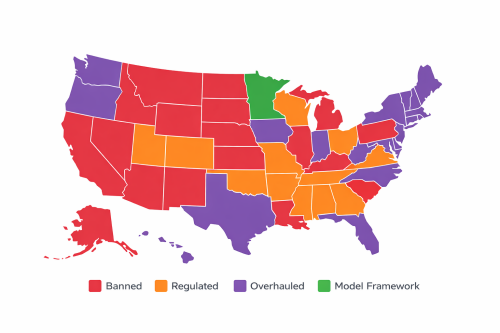
A sweeping federal redefinition of hemp that takes effect in November 2026 has triggered a wave of divergent state legislative responses, creating a patchwork of rules that no two states are applying the same way. Ohio banned most intoxicating hemp products outright. New Jersey is channeling THC beverages into its licensed cannabis framework. Tennessee has overhauled its entire hemp regulatory structure. Minnesota has become the unlikely model that federal legislators point to as the right way to do it.
For a single-location retailer, this complexity might be manageable. For a multi-state operator — or for any retail technology provider trying to serve them — it is, in the words of one of the retail industry’s top trade association leaders, a fundamentally different kind of problem.
The Federal Catalyst: Section 781 and the November 2026 Deadline
The turmoil starts at the federal level. On November 12, 2025, President Trump signed H.R. 5371, a continuing appropriations act that contained Section 781 — a provision that rewrote the federal definition of hemp for the first time since the 2018 Farm Bill. The change was sweeping.
Where the 2018 Farm Bill only measured delta-9 THC, the new law measures total THC — including THCA, Delta-8, Delta-10, HHC, and any other cannabinoid with similar effects. And the new finished-product limit is severe: no retail container may contain more than 0.4 milligrams of total THC. To put that in context, a typical Delta-8 gummy contains 25 milligrams. A hemp-derived THC beverage routinely contains 5 to 10 milligrams. Under Section 781, virtually every intoxicating hemp product currently on smoke shop and vape shop shelves across the country will be federally non-compliant after November 12, 2026.
The law gave the industry a one-year window. That window is now less than seven months away.
Fifty States, Fifty Different Answers
Congress set the federal floor. What states are building on top of it — or in opposition to it — is where the story gets complicated fast. Here is how four states responded to the same federal trigger:
| State | Response to Section 781 | Status | Impact on Retailers |
|---|---|---|---|
| Ohio | Categorical ban on intoxicating hemp products via Senate Bill 56 | Banned — In Effect | Ban in full effect since March 20, 2026. Referendum failed to reach ballot. Two courts have issued TROs blocking enforcement — legal challenges ongoing. |
| New Jersey | THC beverages channeled into licensed cannabis regulatory framework after Nov. 2026 | Regulated — Transition Required | Same product, different legal category. Selling after Nov. 2026 requires a cannabis license, not a hemp product permit. |
| Tennessee | Complete overhaul of hemp regulatory structure via new ABC statutes and rules | Overhauled — Effective July 1, 2026 | New rules govern production, age restrictions, licensure, and penalties. Prior framework described as “barely regulated.” |
| Minnesota | Existing licensing, age-gating, per-serving limits, and labeling standards already in place | Model Framework — Minimal Disruption | Cited by federal legislators as evidence state-level regulation works. Minnesota retailers face less disruption than any other market. |
Update — April 2026: Several of these state situations have moved quickly since this article was first published. Ohio's ban took full effect on March 20, 2026 — the Ohioans for Cannabis Choice referendum effort fell short of the required 250,000 signatures to reach the November ballot, removing that safety valve for hemp retailers. However, courts have since stepped in: a Sandusky County judge issued a temporary restraining order blocking the ban in Fremont, and on April 16, a Franklin County judge issued a second TRO protecting two businesses and calling the law constitutionally discriminatory — reasoning that it unfairly protects Ohio's state-licensed marijuana dispensaries from competition with federally legal hemp products. Both TROs are temporary pending full hearings, meaning Ohio retailers are operating in genuine legal uncertainty. In New Jersey, the April 13, 2026 compliance deadline has now passed — products with more than 0.4mg total THC per container are now legally reclassified as cannabis, and only licensed Class 5 Cannabis Retailers may sell intoxicating hemp beverages through November 13, 2026. Texas enacted sweeping new consumable hemp rules effective March 31, 2026, adding THCA into the total-THC framework, raising licensing fees to $10,000 per facility, and effectively eliminating smokeable hemp products — only to have a Travis County judge issue a TRO on April 8 blocking enforcement. The emerging legal pattern is significant: state bans are drawing constitutional challenges based on interstate commerce and equal protection grounds, adding litigation risk on top of regulatory risk for multi-state operators trying to plan for November 2026.
And the landscape continues to shift. Texas has expanded its medical cannabis program. Alabama is opening its first dispensaries. Pennsylvania’s governor has endorsed adult-use legalization as part of his 2026 budget vision. North Carolina has active adult-use legalization bills moving through both chambers. In November 2026, voters in as many as nine states — including Florida, Nebraska, Missouri, and Idaho — may decide cannabis-related ballot measures.
The legal challenges to state bans in Ohio and Texas are adding a new layer of complexity on top of the regulatory one. A multi-state retailer now faces not just different rules in each state, but the possibility that those rules will be partially suspended by courts while still being enforced by regulators in other jurisdictions. Manual compliance monitoring cannot track a preliminary injunction hearing schedule any more than it can track a legislative session.
Every one of these changes carries a different set of inventory, age verification, tax, and reporting requirements. For a multi-state operator managing locations across even a handful of these states, the compliance picture changes with every legislative session.
The Technology Problem Behind the Compliance Problem
Jim Roddy, President and CEO of the Retail Solutions Providers Association (RSPA), has a clear-eyed view of what this kind of regulatory fragmentation does to the retail technology industry. Sunfire POS recently attended an RSPA Cannabis Community Meeting where payments and technology experts shared updates and best practices on what’s around the corner. We put two questions directly to Roddy afterward.
When asked what challenges state-level variation creates for RSPA members and industry partners, Roddy was direct:
— Jim Roddy, President & CEO, Retail Solutions Providers Association (RSPA)
New technologies have helped retail IT solution providers expand their geographic reach, but regulations that vary by state slow down those expansion efforts. Instead of focusing on designing one best solution and taking that to market, unique solutions need to be developed for specific geographies. For example, if you’re providing hardware, software, and IT services to restaurants in Oregon, you can sell essentially the same solution in Idaho and California as well. But if you’re selling a cannabis solution, the approach in each of those states has to be radically different.
The implication for retailers is just as significant as it is for technology providers. A smoke shop operator expanding from Tennessee into Ohio, or from Minnesota into New Jersey, cannot simply replicate their existing operation. The compliance rules governing what they can sell, how they must verify customer age, what taxes apply to which products, and what records they must maintain are different in every jurisdiction — and they are changing faster than any manual compliance process can reliably track.
When asked what advice he would offer to help members keep pace, Roddy emphasized organizational agility:
Organizational agility is necessary to participate in these highly regulated markets. The best way we’ve seen to keep pace with the changes is to stay close to the market.
— Jim Roddy, President & CEO, Retail Solutions Providers Association (RSPA)
How Sunfire POS Solved the State-by-State Problem
Staying close to the market is necessary. But for a retailer managing multiple locations across multiple states, “staying close” can’t mean manually updating your POS system every time a legislature acts.
Sunfire POS Chief Revenue Officer Gregg Winnington describes how the company addressed this directly:
— Gregg Winnington, Chief Revenue Officer, Sunfire POS
At Sunfire POS, we decided that it wasn’t practical to create a new POS system for each state’s rapidly evolving regulations on high-risk products like CBD, hemp, peptides, and cannabis. We solved the problem by partnering with Qredible, Inc. to integrate their AI-driven, automated compliance platform into our POS. As soon as any state changes a regulation or bans a product line, that rule automatically flows out to our Sunfire POS customers. They stay compliant without having to manually manage each SKU and transaction.
Qredible is the world’s first and only automated product compliance platform. Its integration into Sunfire POS means that when Ohio enacts a ban, when New Jersey changes its licensing framework, when Tennessee updates its age restriction rules — retailers don’t have to catch it themselves, interpret it themselves, or update their systems themselves. The compliance engine has already done it.
Sunfire POS President Mark Landis frames it as building agility directly into the product:
We build that agility into Sunfire POS to help our retailers selling regulated products keep pace with markets in states with regulations and legislation that are constantly changing. When the rules change, our POS system customers don’t have to worry about fines and penalties for non-compliant transactions. The “living, always-on” Qredible compliance engine in their POS system has already done the update.
— Mark Landis, President, Sunfire POS
“Living, always-on” is the key phrase. This isn’t a compliance module that gets updated quarterly, or a checklist a store manager reviews before opening. It is a continuously active system that monitors the regulatory landscape and automatically keeps retailers on the right side of it — in every state where they operate.
What November 2026 Means for Your Inventory Right Now
For smoke shop, vape shop, and CBD retailers, the seven-month runway to the Section 781 enforcement date is not a reason to wait. It is a reason to act. If you sell Delta-8, THCA, hemp-derived THC beverages, or other intoxicating hemp products, four questions need answers today:
- Which of your current products will still be legal after November 12, 2026 — federally and in each state where you operate? The federal 0.4mg container cap will eliminate most of the intoxicating hemp category. But state rules may impose additional restrictions, earlier deadlines, or new licensing requirements.
- What does your inventory transition plan look like? Products that are non-compliant under the new rules cannot simply sit on shelves past the deadline. Liquidation timelines, return-to-vendor agreements, and reformulated product pipelines need to be in place now. In Ohio, retailers who attempted to move non-compliant inventory out of state after the March 20 ban took effect were warned that transporting it could constitute felony drug trafficking under state law — a reminder that inventory planning must happen well before enforcement dates, not after.
- What does your compliance infrastructure look like? If you are manually tracking regulatory changes across multiple states, you are already behind. The pace of change since November 2025 has been faster than any manual process can reliably handle.
- Are your payment processing relationships stable enough to weather a product category transition? CBD, hemp, and vape retailers using general-purpose aggregators like Square or Stripe are already at risk of account freezes. High-risk merchant accounts with dedicated underwriting — like those through Sunfire POS’s integration with Metro Payment Technologies — are structured to handle exactly this kind of transition. Read more about the aggregator freeze risk.
Is Your POS Keeping Pace With the Regulations?
Sunfire POS integrates Qredible’s “living, always-on” compliance engine so your smoke shop, vape shop, or CBD retail operation stays compliant automatically — in every state, as fast as the rules change. No manual monitoring. No compliance surprises. Schedule a free demo today.
Schedule Your Free DemoThe Case for Integrated Compliance
The retailers who navigate 2026 successfully will not be the ones who track compliance best. They will be the ones who have built compliance into their operations so that it does not require active tracking at all. Their POS system will have “fire prevention” built-in so that they don’t have to worry about constantly “fire fighting” every time a rule changes.
As Jim Roddy of the RSPA put it, organizational agility is necessary to participate in these markets. Sunfire POS exists to give retailers that agility — not as a management practice, but as a feature built directly into their point-of-sale system. The deadline is November 12, 2026. The time to get compliant infrastructure in place is now.
This article was featured in the RSPA Community IQ Resource Center.