When the Regulator Walks In, Your POS System Is Either Ready or It Isn’t
How Sunfire POS and Qredible Turn Compliance From a Daily Liability Into an Automatic Advantage for Smoke Shops, Vape Shops, and CBD Retailers
by the Sunfire POS Team
May 18, 2026
Key Takeaways
- Why manual compliance tracking fails at scale — and what the three failure modes look like in practice.
- How Qredible’s policy-first architecture keeps every SKU and transaction automatically current with federal, state, and local regulations.
- What “compliance at the moment of transaction” actually means at the register — and why it matters for your audit trail.
- Why multi-state smoke shop, vape shop, and CBD operators have more to lose — and more to gain — than any other retail category.
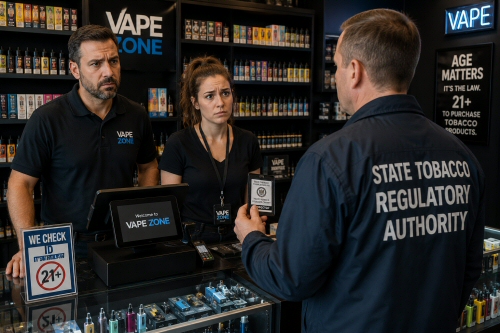 The inspector did not call ahead.
A regional vape retailer with six locations received a surprise visit from a state tobacco regulatory authority on a Tuesday morning. By the end of the visit, three products were flagged as non-compliant with the state’s recently updated nicotine product listing requirements — products that had been on the shelves for four months, products the owner genuinely believed were authorized. The store had a manual compliance binder. Staff had been trained. But no one had caught the regulatory update that had quietly changed the requirements in the prior quarter.
The outcome: a civil penalty, a mandatory product removal, and a formal notice that the retailer’s license was under review. The store’s payment processor received a copy of that notice automatically. The account was flagged for review within 48 hours.
This scenario is not hypothetical. State tobacco and vape regulatory authorities in Tennessee, North Carolina, Florida, and Texas have all escalated enforcement in the last 18 months. The FDA has a $200 million annual enforcement budget for vape product violations. And the regulatory landscape is moving faster than any retailer with a spreadsheet or a binder can reliably track.
The question is not whether your compliance process was good enough when you set it up. The question is whether it is current as of today.
The Compliance Problem That Grows With Your Business
For a single-location smoke shop owner who has operated in the same market for a decade, manual compliance is already difficult. Now scale that to three locations. Then five. Then add a second state. Add a product line that crosses the hemp, CBD, and nicotine boundary. Add a manufacturer whose lab results come in three different formats from two different testing labs. At that point, manual compliance is not just difficult — it is mathematically impossible to do reliably.
Regulated retailers consistently identify three compliance failure modes before they make the move to automated compliance:
The update gap. A state regulation changes. The retailer doesn’t learn about it for weeks — or learns about it from an enforcement action rather than a monitoring system. Products that were compliant on January 1 are non-compliant by March 1, and nothing in the POS flagged the change.
The COA reconciliation problem. Certificate of Analysis documents arrive from labs in different formats, with different testing methodologies, and with results that may or may not align with the product label claims. Manually reconciling COA data against regulatory standards across a 400-SKU inventory is a part-time job. Most retailers don’t have a dedicated compliance employee. They have an owner who is also the buyer, the scheduler, and the shift manager.
The vendor onboarding delay. A new product arrives from a new vendor. Someone has to verify the COA, confirm the product meets state and local standards, check the label claims against the regulatory requirements, and enter everything accurately into the system before the product goes on the shelf. If that process takes two weeks, the product sits. If it takes two days and cuts corners, there is a compliance exposure that may not surface until the inspector arrives.
What Automated Compliance Actually Looks Like
Sunfire POS integrates Qredible — the industry’s leading AI-powered automated compliance management platform — directly into its point-of-sale and inventory management workflow. The integration is not a dashboard you check once a week. It is a real-time compliance layer that operates at the SKU level, on every transaction.
Ronaldo Möntmann, Chief Information Officer at Qredible, describes what makes the platform fundamentally different from legacy compliance approaches:
— Ronaldo Möntmann, Chief Information Officer, Qredible, Inc.
Qredible stands out as a best-in-class platform because it doesn’t just track compliance — it operationalizes it across the entire product lifecycle. Unlike traditional tools that rely on manual review or fragmented systems, Qredible combines AI-driven analysis to validate product claims against COAs and regulatory standards, automated data ingestion from websites, labs, and files at scale, and end-to-end visibility across product sourcing, compliance status, and audit readiness. This creates a single source of truth for highly regulated industries — where accuracy, speed, and transparency are critical. What truly sets Qredible apart is its ability to continuously monitor risk, normalize inconsistent data across vendors and labs, and scale compliance operations without scaling headcount. In short, Qredible transforms compliance from a cost center into a strategic advantage — enabling businesses to move faster, reduce risk, and build trust with partners, regulators, and consumers.
That last phrase — a strategic advantage — is the reframe that matters for regulated retailers. Compliance has historically been a pure cost: staff time, legal exposure, and administrative overhead that produces no revenue. What Qredible and Sunfire POS deliver together is a system where compliance happens automatically, invisibly, and continuously — so the time and attention it used to consume can be redirected to running and growing the business.
Compliance at the Moment of Transaction
The specific value of integrating Qredible into Sunfire POS — rather than running a separate compliance tool alongside the POS — is what Möntmann calls “compliance at the moment of transaction.”
The integration with Sunfire POS unlocks a powerful advantage by bringing real-time, compliance-driven intelligence directly into the point of sale and operational workflow. For Sunfire customers, this means compliance at the moment of transaction — ensuring products are validated against COAs and regulatory rules before they are sold, reducing liability and risk. It also enables seamless product and inventory synchronization, where product data, lab results, and compliance statuses flow automatically between systems, eliminating manual reconciliation and reducing errors. Multi-store operators benefit from enterprise-level oversight across all locations, with centralized visibility into what is being sold and whether it meets compliance standards. Additionally, businesses can onboard new products and vendors faster through automated ingestion and validation, and remain audit-ready at all times — with every transaction backed by traceable compliance data.
— Ronaldo Möntmann, Chief Information Officer, Qredible, Inc.
In practical terms for a smoke shop or vape shop operator, this means:
- A product whose COA has expired or whose regulatory status has changed is flagged in the POS inventory — it cannot be sold through without triggering an alert.
- New vendor products are onboarded through automated data ingestion rather than manual entry and manual verification — cutting weeks off the process.
- Every transaction is backed by a traceable compliance record — not a binder in the back office, but a digital audit trail linked to the transaction itself.
- When a regulator asks for documentation, the answer is a report, not a search through filing cabinets.
When Regulations Change — and They Always Do
The most technically significant capability in the Qredible integration — and the one that most directly addresses the update gap failure mode — is what Möntmann calls the policy-first architecture.
Gregg Winnington, Chief Revenue Officer at Sunfire POS, frames what this means for merchants day to day:
Even in today’s highly dynamic legislative and regulatory environment, Sunfire POS customers know they are automatically current with federal, state, and local regulations.
— Gregg Winnington, Chief Revenue Officer, Sunfire POS
Möntmann explains the architecture behind that statement:
Qredible uniquely uses a policy-first architecture that auto-configures all compliance behavior per merchant. When regulations change, the change occurs at the policy layer, flows as a compliance bulletin, and updates all modules simultaneously. No engineering or coding redeployment is necessary.
— Ronaldo Möntmann, Chief Information Officer, Qredible, Inc.
This is the capability that changes the math for multi-state operators. A retailer with locations in Ohio, Tennessee, and New Jersey is currently navigating three entirely different hemp and cannabinoid regulatory frameworks — frameworks that have each changed materially in the last six months. Under a manual compliance model, each regulatory change requires someone to learn about it, interpret it, update inventory records, and retrain staff. Under Qredible’s policy-first model, the regulatory update flows through the policy layer and every affected module updates automatically.
For multi-state operators, this is not a convenience. It is the difference between operating legally and operating blind.
No Other POS System Does This
Mark Landis, President of Sunfire POS, is direct about where this leaves competitors in the specialty retail POS space:
For smoke shops, vape shops, and CBD stores, no other point-of-sale system in our category offers SKU-level compliance automation capability.
— Mark Landis, President, Sunfire POS
That claim is grounded in a specific architectural reality: compliance automation at the SKU and transaction level requires a real-time integration between the POS and a compliance intelligence platform. General-purpose POS systems — built for restaurants, boutiques, or general merchandise retail — have no native pathway to COA validation, regulatory rule sets for hemp and nicotine products, or policy-layer update architecture. Adding compliance as an afterthought through a third-party app cannot replicate what a purpose-built integration delivers.
For any regulated retailer evaluating POS systems, the question to ask any vendor is simple: when a state regulation changes, how does that change reach my inventory and my transaction flow — and how long does it take?
With Sunfire POS and Qredible, the answer is: automatically, and immediately.
Is Your Compliance System Ready for the Next Inspection?
Sunfire POS integrates Qredible AI-powered compliance automation in every plan — SKU-level, transaction-level, and automatically current with every regulatory change. No manual monitoring. No compliance binders. No update gaps. Schedule a free demo today.
Schedule Your Free DemoWhat This Means for Your Business Right Now
The regulatory environment for smoke shops, vape shops, and CBD retailers is not stabilizing. The November 2026 federal hemp deadline under Section 781, ongoing state-by-state enforcement and litigation, escalating FDA vape product authorization requirements, and the newly formalized DEA registration obligations for licensed cannabis operators are all adding layers of compliance complexity simultaneously.
Manual monitoring cannot keep pace. A compliance binder cannot keep pace. A spreadsheet updated quarterly cannot keep pace.
The retailers who will navigate this environment successfully are the ones who have removed human judgment and manual process from the compliance decision — and replaced it with a system that monitors, validates, and updates automatically.
That is what Sunfire POS and Qredible deliver, purpose-built and fully integrated, in every Sunfire POS plan.